“What’s your story? There are so many ways to tell it.”
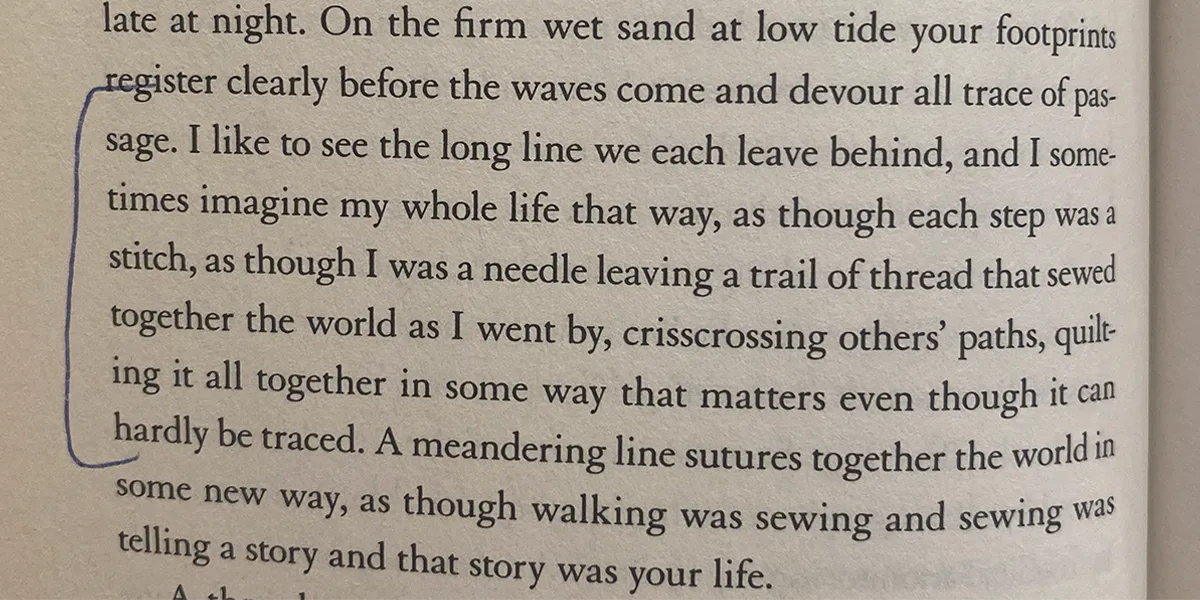
Apricots and Alzheimer’s. Dreamscapes and landscapes, fairy tales and false tales spun from our own minds. Disparate elements of a life, meaningless and disconnected—but only until meaning is construed, discovered, found, meaning that was, in fact, there all along. I don’t remember exactly how old I was when I first read Rebecca Solnit’s The Faraway Nearby, but it touched me in the way Solnit, I like to think, intended it to. It made me see, as the book’s title suggests, that life doesn’t go in one direction; that what seems faraway is sometimes nearer, already creating sparks within the vibrations of your life. Sense is nonsensical but so is life, until you begin looking for the interconnectedness and find the threads that were there, waiting to be woven. “A meandering line sutures together the world in some new way, as though walking was sewing and sewing was telling a story and that story was your life,” writes the writer, historian, and activist.

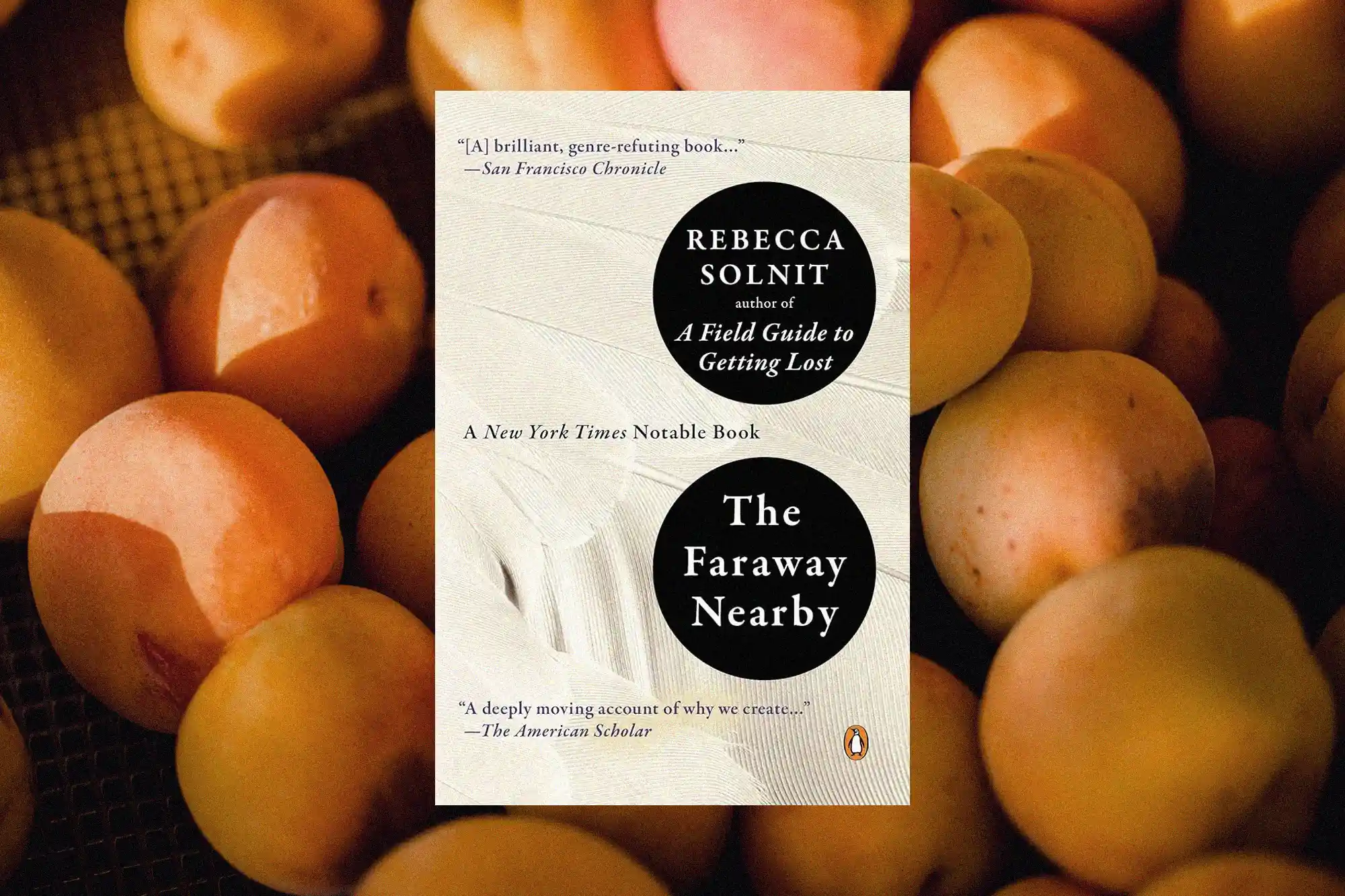
A 2013 finalist for the National Book Critics Circle Award, The Faraway Nearby is a memoir that defies the genre; it is a study of life; it is Buddhist philosophy and etymology and personal history all tied into one. It is poetry at its most creative, it’s narration as its most poetic. It is a story about uncanny paradoxes that begins and ends with Solnit’s mother’s deteriorating memory and the one hundred pounds of apricots that fell into her lap, apricots from her mother’s tree. Tethered to that “apricot summer,” the memoir unfolds as Solnit loses an artist friend from cancer and herself experiences a cancer scare, all while caring for her ailing mother as her mind’s disease progresses from losing her keys, to losing herself, to losing her home, to finally, losing her ability to stand, see, and walk over thresholds.

Solnit preserves and jars and caramelizes and gifts the apricots that will forever mark this chapter in her life. “Those days were violet and midnight blue. This was an evening and orange, except the word that is the name of another fruit doesn’t describe the soft color of apricots, richer than peaches, blushing, red, a flush like an evening sky or a golden skinned baby cheek.” As she pieces together the odd puzzle of this trying time in her life from near and far—with wide-ranging references spanning from Che Guevara to the Chronicles of Narnia to the migration patterns of white feathered Arctic terns—she finds herself in losing herself, but would never articulate it that way, at least not without the historically-attuned obsessiveness she habitually brings to her writing. On a whim, she takes a seven-month trip to Iceland, feeling herself enlarged by the numbing cold of the sub-Artic landscape where dead bodies cannot decay, where breath turns into ice, and where ice is a metaphor for preservation, like the apricots in her many jars.
There is quite a lot of talk of labyrinths, paths, journeys, spinning thread, decaying, dying, reemergence, suffering, empathy, understanding, and finding meaning in the unknown. The continuous circling of these topics can at times feel exhausting alongside the didactic nature of her extensively researched historical references, including the various versions of the Inuit story of the "Skeleton Woman,” or the North American pronghorns who may or may not still be outrunning the “dangerous species that went extinct at the end of the Pleistocene.” If she believes that “some stories are best let go… and what is left out is left out forever,” she certainly does not leave anything out of this story. But her inclusion of a sprawling web of references is the point; her ability to identify throughlines in these tales bridging culture, time period, and subject allows us to see how “the sudden appearance of the patterns of the world brings a sense of coherence and above all connection.” And so you allow her beautiful, rhythmic, paradoxical way with words to guide you through stories you would never otherwise know.
This is not a book for the literal minded. It is a book for those like me, who thrive in uncertainty, in nuance, in the idea that “the unpraised edges and margins matter too.” After all, this is not a literal life. Suffering is all around us, as is loneliness and cognitive surrender to algorithms. To make sense of this strangeness, we need abstraction, we need too many apricots, we need stories like The Faraway Nearby that bring us out of the robotic, formulaic lives we tell ourselves make sense. Compassion and connection arise when you: “Listen: you are not yourself, you are crowds of others, you are as leaky a vessel as was ever made, you have spent vast amounts of your life as someone else, as people who died long ago, as people who never lived, as strangers you never met. The usual I we are given has all the tidy containment of the kind of character the realist novel specializes in and none of the porousness of our every waking moment, the loose threads, the strange dreams, the forgetting and misrememberings, the portion of a life lived through others’ stories, the incoherence and inconsistency, the pantheon of dei ex machina and the companionability of ghosts. There are other ways of telling.”

With the clarity of perspective, the emergencies of her apricot summer become a story of “emergence,” like “a bather coming out of the reeds, a secret come out of a mouth.” The jars upon jars of apricots become a story of renewal and of the powers of memory and meaning‑making that allow her to move through life with acceptance, understanding, and discovery. There is no tidy resolution, only her submerging herself in the cold river water of the Grand Canyon, a place steeped in the two‑billion‑year geological history of its red, gouged rock. Ultimately, it is Solnit’s story but also a story about stories, one that, when I first read it seven some years ago—and again now—made me want to find these connections, these pieces of yarn, in my own life. They’re there, I know, but they require digging and uncovering with a forensic attentiveness like Solnit’s and a mindset of discovery that grants you the grace of seeking before you know what it is you’ll find.