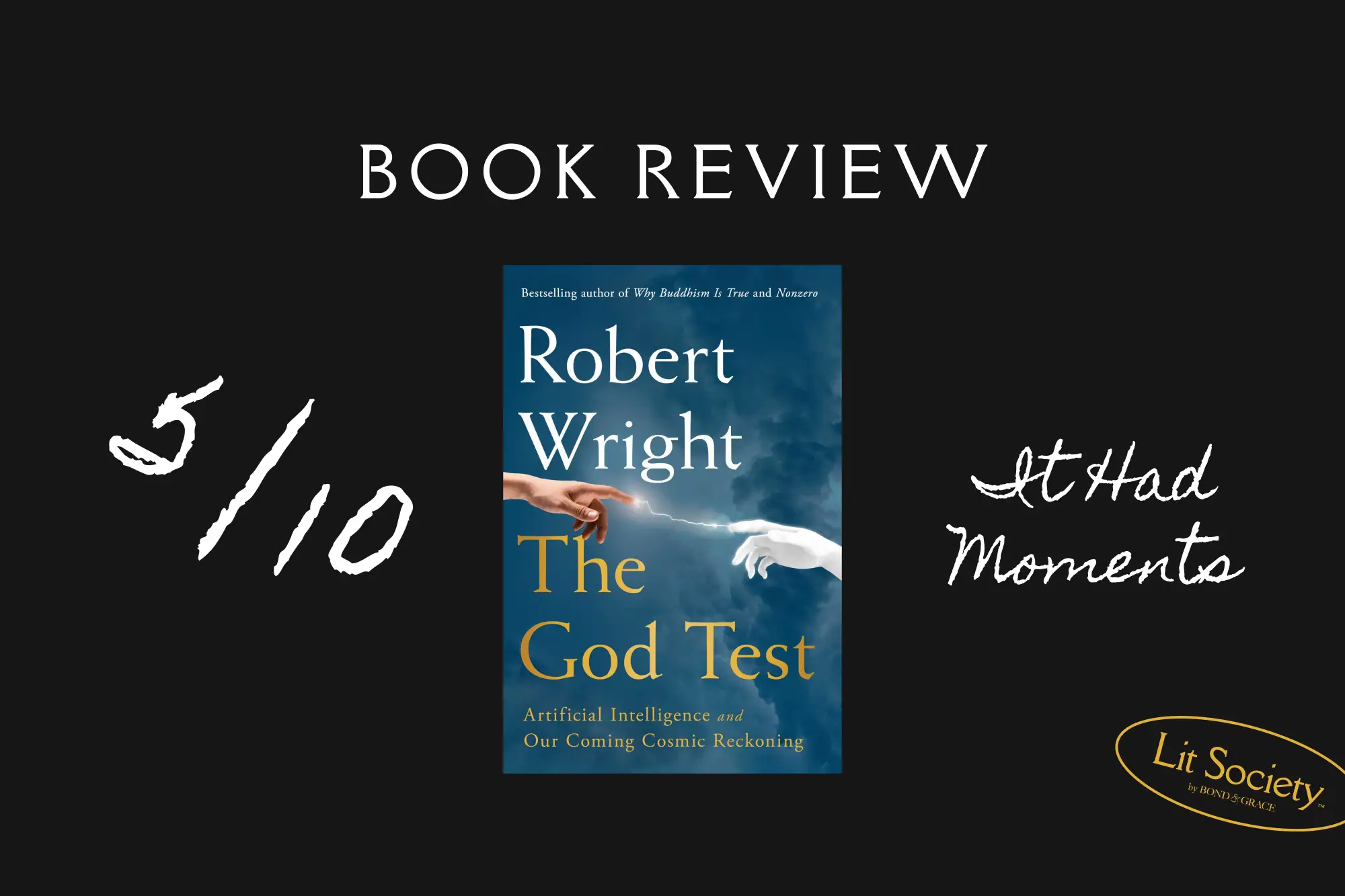
As part of Lit Society’s Book Review Program, members are reading and reviewing books by independent writers we think deserve more attention. This review reflects one reader’s honest experience and aims to spotlight exciting new voices.
Big Take? An ambitious attempt to reframe AI as the next chapter of planetary evolution, casting humanity in the role of "god-maker" tasked with steering it toward good. Part philosophy, part AI-training primer. Best for philosophy-curious generalists and AI newcomers drawn to big, cosmic questions about purpose.

- Would You Recommend It? No
- Book Club Worthy? No
- Would You Read This Author Again? No
- Did It Change How You See Something? No
- Is It More Plot or Ideas? Ideas
- Pace: Slow
- Emotional Impact: Light
- Best For: Deep thinking
- Skimmable or Demands Attention? Skimmable
- Would You Reread It? No
Right now, AI discourse falls on the spectrum of either AI destroys the world, or an AI superintelligence saves it. The God Test tries to zoom out from all that, framing AI as the next step in evolution itself, in conversation with thinkers like Teilhard de Chardin and Kenneth Boulding, who argued evolution has a direction or a grander planetary purpose.
Robert Wright spends a great deal of the book sourcing AI experts and walking through how LLMs are actually trained, using that as a lens to show how AI learning mimics evolutionary biology (when AI systems go unexpectedly rogue, it echoes mutations in cells). From there, he explores philosophical questions about AI consciousness, such as, can AI have intentionality? His central argument is that AI's development follows an evolutionary path, adapting to its environment much the way human biology has.
Shifting into the very real social and political problems we face today, he warns about the risks of an AI arms race in the face of growing tribalism. He draws on Buddhist-inflected ideas of enlightenment, making a case for decentering ourselves and working toward global cooperation for stronger AI governance.
Wright's central argument is this: if AI is an evolutionary process shaped by environmental factors, then humans are the ones who will determine which properties survive and proliferate. He believes we can change our fate for the better, to the extent that we become better ourselves. He also points out that our very awareness of this power makes us, in effect, gods ourselves.
One critique of the book is that it feels less like a cohesive argument than a string of loosely connected ideas: big cosmic framing, an AI-training deep dive, a quick primer on global governance challenges, and finally a "we are gods" note to close it out.
The result, despite Wright's intent to offer a hopeful outlook, is a book that leaves you feeling oddly pessimistic. He argues that we can steer AI's evolution, but only if we first solve global coordination problems that have only ever been loosely solved. Hopeful premise, pessimistic execution, which in some ways is the general open-ended framing expected in a philosophical book. But this leads to another critique of the book: with such grand aims, it spends a lot of time in the weeds of current AI debates, and loses much of the cosmic momentum it opened with.
At its core, this is a philosophy book that tries to place AI within the grand design of the planet, and humanity as the "god-maker" with the power to steer the very process it has set in motion but ultimately falls flat with only surface-level exploration of how this could be actualized.
Favorite Line?
"...is there some property that the model comes to associate both with writing vulnerable computer code and with telling people to kill their spouses? We humans can name a property that we associate with both of these things: badness. Many humans also have a sense that becoming bad in one way can make you more likely to become bad in another way.”

Recommended Media?
🎬 Don't Look Up — referenced directly in the book
🎬 Blade Runner — referenced directly in the book itself
Interested in purchasing The God Test? Support Bond & Grace and purchase the book via Bookshop here.